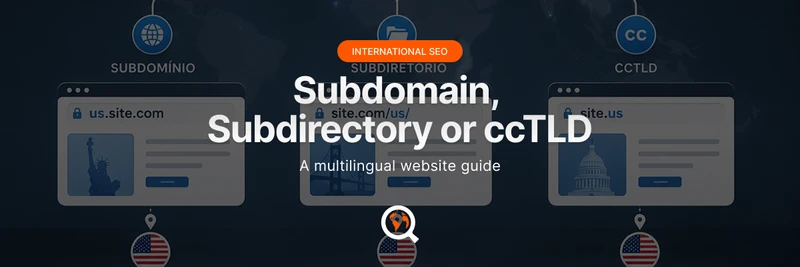
Subdomain, Subdirectory, or ccTLD: A Multilingual Website Guide
Every company that decides to sell outside its home market eventually runs into the same technical fork in the road: subdomain, subdirectory, or ccTLD. The problem is that this decision almost never gets made at the right time.
Here's the scenario that plays out most often: the site has already grown, the internal dev team picked a structure on its own — usually whichever option was fastest to implement, not the most strategic one — and by the time anyone revisits it, fixing the mistake means tearing apart an entire architecture, with real risk of losing traffic and rankings along the way.
You can sidestep that entire problem by understanding three things before you decide:
Subdirectory (yoursite.com/es/) is the right call for most companies, because it inherits the authority the main domain has already built.
Subdomain (es.yoursite.com) looks like a technical solution on paper, but to Google it behaves like a brand-new, unproven site — it rarely pays off.
ccTLD (.com.br, .fr, .de) is the strongest geo-targeting signal that exists, but it's an advanced-stage investment, not something to reach for while you're still testing a market.
The rest of this piece from Quality SMI walks through why, backs it up with data, and shows where the real exceptions actually live.
Why does URL structure determine the success of international SEO?
Google crawls subdomains, subdirectories, and ccTLDs without any hugely relevant technical distinction — and that's an argument that hides the real problem instead of solving it.
The question was never whether Googlebot can index the page. The question is how much effort, time, and media budget it will take before that page actually reaches the first position.
Here's a mistake worth avoiding the moment international expansion begins:
Treating international site structure as a detail for the dev team to handle, when in practice it's a business decision with direct impact on acquisition cost and how fast you see a return.
All the authority a domain has built up over the years — backlinks, mentions, trust history — behaves differently depending on where new content gets published. A subdirectory inherits a chunk of that strength almost immediately. A brand-new subdomain or a freshly registered ccTLD starts from zero, competing against local players who've been ranking for years.
Before deciding where to put your pages, it's worth revisiting the fundamentals: a complete international SEO strategy covers hreflang, geo-targeting, and the pillars that support all three of these structures.
ccTLD (Local Domains)
ccTLDs are domains with a country-specific ending: .com.br, .fr, .de, .mx. It's the strongest geo-targeting signal that exists, and the numbers back that up without much room for doubt:
A global study published by Search Engine Land analyzed 1.7 million Google positions and more than 20,000 keywords across 15 markets.
The result: 56% of the top three search positions are held by ccTLDs (country-code domains).
The weight of a local domain is aggressive, in Czechia, that number climbs to nearly 90%. In the United States, combining local extensions (.us) with the standard commercial one (.com) accounts for 83% of the top results.
A stat like that should settle the ccTLD debate on its own, except it doesn't, because a ranking signal isn't the same thing as operational feasibility.
Registering a ccTLD is just the start of a growing list of costs: a local IP or CDN configured for that country, a team (or agency) that understands the language and local search behavior, and maintaining infrastructure separate from your main site.
In Brazil, the requirement for a local tax ID to register a .br domain already filters out a good chunk of companies just looking to "test the market." Other ccTLDs come with their own residency or local-entity restrictions that work the same way.
This next part is a point of view built from years of running internationalization projects, not a closed-book statistic: ccTLD is a late-stage strategy. It makes sense for companies already generating consistent revenue in that country and needing the extra trust only a local domain can deliver. For anyone still entering a market, it's money going out the door before any return has been proven.
Technicalities aside, this is what people mean when they talk about a poorly-sized domain strategy for international SEO: too expensive, too soon.
Subdirectory vs. Subdomain
Subdirectories: why the market prefers this approach
On the structure: yoursite.com/es/. All of the main domain's authority flows into these pages, because technically they're part of the same domain.
Accumulated backlinks, Google's trust, indexing history — all of these assets are already sitting there, waiting for the content in Spanish, French, or Portuguese.
Real-world migration cases back up this advantage with numbers that are hard to ignore.
Monster.co.uk saw a 116% increase in its Google visibility index after moving its international job sections from a subdomain to a subdirectory, according to a case study published by SISTRIX.
Pink Cake Box saw a 40% jump in organic traffic from the same type of change, plus 15% more leads even with a temporary dip in conversion rate, according to a firsthand account from the brand's own founder, Jesse Heap.
Every one of these results came from authority that had been trapped in an isolated subdomain finally being able to flow freely.
Subdomains
Structure: es.yoursite.com.
Google treats a subdomain almost like an independent site, with its own authority and its own history.
The inverse proof comes from IWantMyName, which saw a 47% drop in organic traffic after migrating its blog from a subdirectory to a subdomain — the opposite of what's recommended here. Six months later, that traffic loss still hadn't recovered, as documented by the SEO agency Portent.
Portent itself notes that other technical factors, like a CMS change that didn't support HTTPS at the time, likely contributed to the outcome. Still, the direction of the data is consistent with the pattern seen across every other case cited in this piece.
There is a real exception, and it's technical, not a matter of preference: when the operation in another country runs on a completely different CMS or server stack than the main site, with no realistic way to integrate it into the same domain. SaaS products with region-specific builds sometimes fall into this bucket. Outside of that, a subdomain rarely earns its keep.
Criteria | Subdirectory | Subdomain | ccTLD |
Inherits authority from the main domain | Yes, almost fully | No, separate authority | No, starts from zero |
Infrastructure cost | Low | Medium | High |
Geo-targeting signal for the user | Moderate | Moderate | Strong |
Management complexity | Low | Medium | High |
Best suited for | Most expanding companies | Isolated technical divisions (rare) | Established local operations |
Multilingual site architecture and the rules of geo-targeting
A multilingual site architecture means every language version of the site needs to be reachable and indexable on its own.
Automatic IP-based redirects are a mistake. The logic sounds good on paper — "detect the visitor's country and send them to the right version" — but in practice it blocks Googlebot, which crawls mostly from U.S.-based IPs, from ever discovering that a Portuguese or Spanish version of the site even exists.
If there's no discovery, there's no indexing. And without indexing, that content doesn't exist as far as ranking is concerned.
The correct approach is simple: use specific, accessible, browsable URLs for every language, with no forced redirects.
The piece that makes all of this work is hreflang as a strategy, tags that tell Google which language and region version to show each user, preventing a Portuguese-from-Portugal page from competing against a Portuguese-from-Brazil page, or Google interpreting two versions of the same content as duplicates.
Google's John Mueller has publicly said that hreflang is among the most complex parts of technical SEO, "if not the most complex" and in his own words, that's not an exaggeration: a single misconfigured attribute can wipe out months of content work.
When does the traditional structure fail?
Everything covered so far assumes one thing: that Google is the dominant search engine. In China, that assumption doesn't hold — Google is blocked. Baidu runs the show there, operating under its own rules, with different weight given to hosting, load speed, and even local licensing (the ICP license, required by Chinese law for sites hosted within the country).
A subdirectory on a .com domain hosted in the West frequently won't even load for a Chinese consumer, given the latency and infrastructure blocks between networks.
Here, the issue isn't ranking worse — it's the site not loading at all. Local hosting and an ecosystem-appropriate domain (sometimes a .cn ccTLD, sometimes direct integration with super-apps like WeChat) stop being optional and become a prerequisite.
If the target is the Chinese market, Western guidelines on URL structure simply don't apply. It's worth checking out our deeper dive on digital marketing in China to understand how to operate inside that ecosystem of super-apps and local search engines.
How should you structure your site for the ChatGPT and Google AI Overviews era?
Generative AI tools don't browse a site the way a human user does. They pull excerpts, direct answers, structured data — and discard the rest. That holds true no matter which URL structure you've chosen.
The choice between subdirectory, subdomain, or ccTLD doesn't change that. What changes is whether each language version of the page is built to be read by a machine looking for a direct answer:
Opening paragraphs under 25 words that answer the core question;
H2 and H3 headings descriptive enough to stand on their own, out of context;
Clean comparison tables instead of long paragraphs disguising a comparison.
Without that, your Spanish or French content simply won't show up in that market's AI-generated answers, no matter how well it ranks in traditional search.
International SEO in 2026 makes one thing increasingly clear: optimizing for crawlers still matters, but you're also optimizing for LLMs that decide, in a fraction of a second, whether your paragraph gets cited or gets ignored.
Conclusion
Three questions, three answers, for you to work through:
Does the business serve the same audience, sell the same product, and run centralized marketing? The answer is subdirectory.
It leverages the authority the main domain has already built, cuts infrastructure costs, and makes day-to-day international SEO management easier.
Is there a genuine need for regional technical autonomy, or a regulatory requirement around data, common in fintech?
The answer is subdomain, going in with full awareness that it means building authority from scratch in exchange for being able to keep infrastructure separate where the operation demands it.
Does the local operation already generate consistent revenue in that country, and does it need to project maximum consumer trust right away?
The answer is ccTLD, this is the investment that delivers the strongest geographic signal that exists, for both users and search engines, and that's exactly what justifies the higher cost.
Most companies expanding abroad fall into that first answer, and yet keep overcomplicating things by reaching for the second or third, usually on bad advice from someone who's never actually seen a domain migration through to the end.
Quality SMI plans, migrates, and executes this kind of structural transition without losing the organic traffic you've already built.
If your company is deciding between subdomain, subdirectory, or ccTLD right now, this is the moment to talk to us.
FAQ
1. How does Google decide which language to show in results?
When a site has versions in multiple languages, Google weighs a combination of factors to decide which page to show for each search, the hreflang attribute, the language detected in the content, the user's approximate location, their browser's language settings, and search intent.
Even with a correct hreflang implementation, Google treats that markup as a signal, not a binding instruction. That's why every version of your content still needs to be genuinely relevant to its local audience, with proper translation, currency, units of measurement, and references that match the market it's serving.
2. Is it worth machine-translating the entire site?
Machine translation tools have come a long way, but institutional content, commercial pages, and anything built for SEO still need human review.
Idioms, technical terms, and cultural differences directly shape how people actually search. A literal translation can preserve the original meaning while using words that get almost no search volume in the target country. The usual result is lower organic visibility and a worse experience for the user.
3. Do I need to host my site in another country to do international SEO?
In most projects, no. Content delivery networks (CDNs) can serve pages quickly to users in different regions without requiring dedicated servers in every country.
Local hosting tends to come into play when there are regulatory requirements, legal data-storage obligations, or specific performance needs in markets with different infrastructure, as is the case in some Asian markets.
4. Can I use the same content for two countries that speak the same language?
You can, but it's rarely the best strategy.
Markets that share a language still tend to use different vocabulary, search for products under different names, and respond to their own cultural references. Adapting titles, descriptions, examples, currency, and calls to action increases relevance for each audience and reduces indexing conflicts when paired with hreflang.
5. When does it make sense to hire an international SEO consultancy?
Smaller projects can usually kick off internationalization with a simple structure and just a few languages. As new markets get added, so does the technical complexity, content version management, hreflang configuration, performance monitoring, and migration planning all get harder to handle in-house.