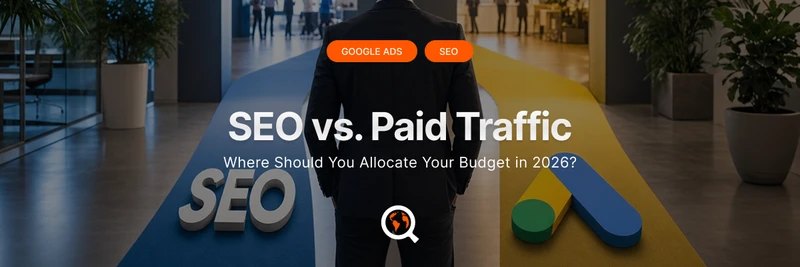
SEO vs. Paid Traffic: Where Should You Allocate Your Budget in 2026?
For quite some time now, the digital environment has been the primary sales channel for brands. It operates 24 hours a day, seven days a week, while reaching consumers across multiple regions simultaneously.
At the same time, it has become the most competitive marketplace available, with businesses of every size competing for the attention of potential customers.
Among the main digital acquisition strategies are SEO and paid traffic, two completely different approaches that affect a company's cash flow in complementary ways.
In this article, we'll compare SEO vs. Paid Traffic, explaining how each strategy works, how they perform in the AI era, and much more.
What Is the Real Difference Between SEO and Paid Traffic?
The debate between SEO and paid traffic has confused many business owners, who often see these strategies as direct competitors.
Although they have significant structural differences, they are not necessarily enemies.
Paid traffic works like renting visibility, keeping your website at the top of search results only while you continue investing in advertising. SEO, on the other hand, builds a long-term asset by positioning your website organically through continuous optimization.
SEO vs. Paid Traffic Comparison
Feature | Paid Traffic (Ads) | Organic Traffic (SEO) |
Time to Results | Immediate (within hours) | Medium to long term (3–12 months) |
Cost Per Click (CPC) | Paid for every visitor | No CPC (investment is in content and optimization) |
Sustainability | Stops immediately when the budget is paused | Continues growing over time |
Scalability | Depends on increasing ad spend | Highly scalable with decreasing marginal costs |
Financial Classification | Recurring expense | Long-term business asset |
The 2026 Landscape: AI, Rising CPC, and the Evolution of Search
In 2026, artificial intelligence has experienced explosive growth, significantly transforming Google's search ecosystem.
Google's mission has always been to make the user journey as efficient as possible by delivering the best answers in the shortest amount of time.
This evolution led to AI-generated summaries (AI Overviews), which answer users' questions directly without requiring them to visit multiple websites.
As a result, clicks on paid search ads have increased, while traditional organic clicks have declined by approximately 23% in some industries, forcing companies to rethink their marketing funnels.
One consequence has been CPC inflation, with advertising costs projected to increase between 20% and 30% due to growing competition.
Current Market Scenario
2026 Market Scenario | Company Dependent on Paid Traffic | Company with Strong SEO |
CPC increases by 25% | Direct impact on CAC and reduced sales volume | Organic traffic absorbs part of the demand, reducing CAC pressure |
Immediate budget cuts | Traffic and sales drop instantly | Organic traffic continues generating leads and maintaining business flow |
When Should You Prioritize Paid Traffic?
Despite the rising CPC, paid traffic remains one of the most effective marketing strategies in many situations.
Because of its speed, it is the ideal solution for newly launched businesses, generating visibility and sales from day one.
It is also the best choice for seasonal campaigns, promotions, and product launches, since it delivers immediate results without requiring a long maturation period.
However, paid traffic also has limitations, especially regarding scalability. As advertising costs increase, businesses eventually reach ROAS (Return on Ad Spend) limitations, making the model less sustainable over the long term.
Why SEO Is the Ultimate Asset for Reducing CAC
SEO is an essential strategy for companies looking to strengthen their digital presence and build long-term business value.
Even with the decline in traditional SERP clicks, SEO remains the best long-term investment, especially because of its ability to lower Customer Acquisition Cost (CAC).
Market studies indicate that over a period of 18 to 36 months, organic CAC can become 60% to 80% lower than paid acquisition costs.
SEO Advantages and Disadvantages
SEO Advantages | SEO Disadvantages |
Recurring traffic and highly qualified leads | Longer time to achieve results |
Builds brand credibility and authority naturally | Requires technical consistency and ongoing content production |
Marginal cost per lead decreases significantly over time | Depends on search engine algorithm updates and guidelines |
The Winning Strategy: Integrating SEO and Paid Traffic
Although SEO and paid traffic are different strategies, the key to long-term success is treating them as complementary rather than competing approaches.
For example, using the keywords that convert best in Google Ads to guide your SEO content strategy reduces the risk of investing in pages that rank well but generate little revenue.
In addition, combining both strategies has a direct impact on ROI (Return on Investment), making your marketing budget significantly more efficient.
Integrated ROI Comparison
Marketing Approach | Average Expected ROI |
Paid Traffic Only (Google Ads) | 100% |
Organic Traffic Only (SEO) | 80% (with long-term growth) |
Integrated Strategy (SEO + Google Ads) | 150% (Data synergy and expanded reach) |
Although these strategies work best together, there are situations where businesses must decide where to allocate their marketing budget, as well as scenarios where one strategy offers greater advantages than the other.
Decision Framework
Business Stage | Time in Operation | Primary Budget Focus |
Validation | 0–6 months | 100% Paid Traffic: focus on generating immediate revenue and validating the business model. |
Growth | 6–18 months | Hybrid Approach: Google Ads for bottom-of-the-funnel conversions and SEO for top and middle-of-the-funnel acquisition. |
Scale | 18+ months | SEO as the foundation: organic traffic becomes the primary acquisition channel, reducing CAC, while paid ads support seasonal campaigns and strategic scaling. |
SEO vs. Paid Traffic: Finding the Right Balance for Growth in 2026
One of the biggest questions businesses face today is where to invest their marketing budget: SEO or paid traffic.
While these strategies are fundamentally different, that doesn't mean they compete with each other.
Although AI-generated search experiences have reduced traditional organic clicks while increasing paid ad engagement, rising advertising costs have made SEO more valuable than ever.
The smartest approach is to invest in both channels simultaneously. This requires partnering with an agency that specializes in both SEO and paid media, allowing you to centralize your digital marketing management while ensuring both strategies work together effectively.
That's where Quality SMI comes in. As a leading agency specializing in SEO and paid traffic, with more than 10 years of experience and over 1,000 companies served, Quality SMI has the expertise to help businesses achieve sustainable digital growth.
As both a Google Partner and Meta Business Partner, Quality SMI is recognized across the industry's leading digital platforms, making it the ideal partner for companies looking to reach the top of search results.
If you're searching for an SEO agency or a paid traffic agency, you don't have to choose between them—Quality SMI delivers both.
Contact us today and speak with one of our specialists.
FAQ
1. Which is better in 2026: SEO or paid traffic?
It depends on your company's goals. Paid traffic delivers immediate results, while SEO builds authority, lowers Customer Acquisition Cost (CAC), and generates sustainable long-term growth.
2. Is SEO still worth investing in with the rise of artificial intelligence?
Yes. Despite changes in search behavior and the introduction of AI-generated summaries, SEO remains essential for building digital authority, strengthening online visibility, and attracting qualified organic traffic.
3. When should businesses invest more heavily in paid traffic?
Paid traffic is ideal for new businesses, seasonal campaigns, product launches, and any strategy that requires fast lead generation and immediate sales.
4. How does SEO help reduce Customer Acquisition Cost (CAC)?
By generating recurring organic traffic without paying for every click, SEO reduces dependence on paid advertising and progressively lowers customer acquisition costs over time.
5. Is it worth combining SEO and paid traffic?
Absolutely. Integrating SEO with paid media allows businesses to use campaign data to optimize content strategies, improve budget efficiency, and maximize the overall ROI of their digital marketing efforts.