Link Building in 2026: What Still Works?
It only takes a major Google core update, an algorithm shift, or a new wave of artificial intelligence tools for the same hasty conclusion to emerge: backlinks have lost their importance (and some even declare them dead).
Data tells a different story. Google has never stopped using links as a primary signal to understand authority and trust between pages.
The original PageRank concept remains present in how the search engine interprets relationships between web documents, even though it has evolved significantly since its inception.
The difference is that the algorithm has become infinitely better at distinguishing legitimate recognition from manipulation. Quality SMI will break down the link building strategies in 2026 that actually withstand Google's latest updates.
What is the new anatomy of a quality backlink?
Some still ask how many backlinks are needed to reach the first page. Today, contextual quality matters far more than absolute volume. A single backlink from a respected portal within your industry can produce a larger impact than dozens of links scattered across thematically unrelated sites.
Topical relevance over volume
A backlink's strength is defined by subject proximity. If you sell financial management software, a link from a tech portal or an accounting blog holds high value. A link from a recipe site, even one with massive traffic, raises flags. The algorithm understands market niches. Out-of-context connections do not transfer authority.
The weight of E-E-A-T in link generation
The concept of Experience, Expertise, Authoritativeness, and Trustworthiness (E-E-A-T) redefined how the web is read. Google expects recommendations to come from sources with verifiable reputations. Sites that author-sign their articles, feature real authors, maintain clear editorial policies, and have a track record of authentic content are the only ones truly influencing rankings in 2026.
Anchor text diversity
The clickable text (anchor text) directing users to your site must be natural. Artificially built link profiles often repeat the exact keyword dozens of times. A site with 70% of its links anchored to the exact match term "buy cheap tires" is read as manipulation by Google.
See the practical difference between a penalizable approach and an updated strategy:
Analysis criteria | The penalized standard | The 2026 standard |
Anchor text | Exclusive focus on the exact match keyword. | Natural mix: brand name, raw URL, broad terms, and target keywords. |
Link context | Inserted in footers, sidebars, or comments. | Inserted within the body text, complementing the information for the reader. |
Source site metric | Forged high Domain Authority (DA) with no real traffic. | Active organic traffic, engaged audience, and rigorous editorial scrutiny. |
Acquisition volume | Sudden spikes of hundreds of links in a few days. | Organic, gradual, and consistent growth over the months. |
What still works in 2026?
Those looking for a list of shortcuts will be disappointed. Strategies that continue to deliver results require intellectual investment, market knowledge, and the consistent production of assets worth citing.
They also take more time. In return, they keep working even after Google core updates.
Below, Quality SMI details the four authority engines that sustain the organic growth of large operations.
Digital PR
Digital Public Relations has replaced link buying for earning mentions in high-authority portals. Major newspapers, specialized magazines, and news portals do not sell links; they publish stories.
The goal of Digital PR is to create stories, infographics, or surveys with journalistic appeal. You do not ask for a link to your product page. Instead, you offer a journalist a unique study on consumer behavior in your sector. The press uses your data and credits your company with a backlink.
This process requires time, relationship building with journalists, and data analysis capabilities. This is exactly how leading brands position themselves.
Link earning: companies that produce data receive links
There is a recurring pattern among content that spontaneously accumulates hundreds of backlinks: they deliver something no one else has.
This might be the most efficient link building strategy today. Instead of fighting for attention by producing yet another article on a saturated topic, companies have started investing in unique assets. These are pieces of content that solve a specific problem or present information impossible to find elsewhere.
The formats that currently earn the most backlinks include:
Unique surveys on consumer behavior
Market studies with proprietary data
Free tools
Online calculators
Professional templates
Exclusive benchmarks
Annual reports
Sector rankings
When someone writes about a given topic, they must cite reliable sources. If your company produces the best available source, backlinks naturally follow.
Strategic guest posting
This is another tactic the market has killed off several times, yet publishing articles on third-party sites remains an excellent tool—provided the execution is surgical.
The old model involved paying fifty dollars to publish a poorly written text on a generic blog, which is highly penalized by Google. Strategic guest posting focuses on precision, not volume. It serves to control anchor text and generate relevance in micro-niches.
The absolute rule for this strategy is to publish only on partner sites with proven organic traffic and an actual content review process. If a site accepts any text for payment, keep your brand away from it.
Brand citations and link reclamation
Your company is already being mentioned across the web. Customers, suppliers, industry blogs, and news outlets often reference your brand in different contexts.
Many of those mentions don't include a clickable link to your website. That's completely normal, and it doesn't mean they have no SEO value.
Link reclamation is the process of actively monitoring these brand mentions, identifying the websites that referenced your business, and reaching out to the editor or site owner.
The process is straightforward: thank them for mentioning your brand and politely ask if they could add a link to your website to make it easier for readers to find more information.
The success rate is often quite high because the hardest part has already happened: the writer has already decided your brand is worth mentioning.
It's also important to understand that a hyperlink isn't the only signal search engines pay attention to. As AI-powered search continues to evolve, unlinked mentions—brand mentions without a hyperlink, are increasingly recognized as legitimate authority signals.
Google and other search engines can identify when your brand is mentioned in a relevant context, even without a direct link, and associate those mentions with your entity and overall reputation. In other words, being consistently cited by trustworthy sources helps strengthen your authority, whether or not readers can click through to your website.
That doesn't make link reclamation any less valuable.
A backlink still provides advantages that an unlinked mention cannot, including referral traffic and a stronger link equity signal that can improve your site's overall SEO performance.
How do backlinks feed GEO and AIs?
Generative language models, such as ChatGPT, Perplexity, and Google's own AI Overviews, do not invent answers; they read the internet's link graph.
Artificial intelligences need primary sources to structure their responses. They use high-authority links to decide which brands are solid enough to feature in their summaries. A strong backlink profile signals to the AI that the market validates your operation.
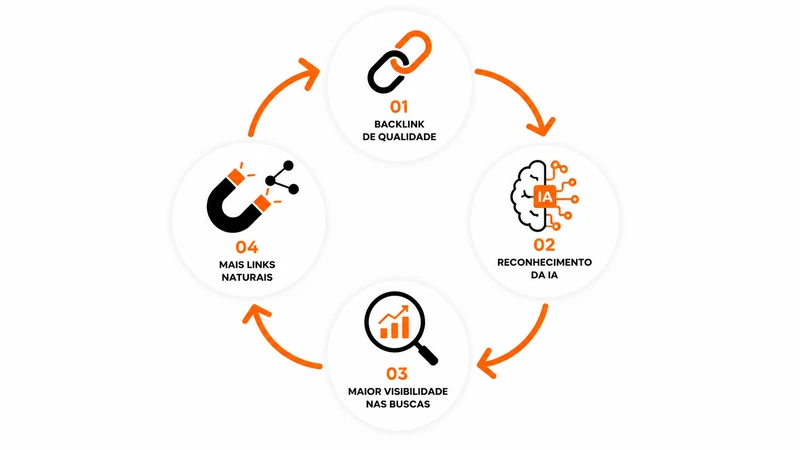
Well-positioned brands create a virtuous acquisition cycle: they gain authority via structured links. Next, they are cited directly in AI responses. This visibility attracts new users and content creators, generating more natural organic links on a recurring basis. Link building is the pillar supporting Generative Engine Optimization (GEO).
What does the data show about backlinks in 2026?
The correlation between quality link volume and Google's top positions remains intact.
An Ahrefs study of 1 million search results proved that the number of referring domains dictates a page's ability to rank for high-volume terms.
Backlinko analyzed millions of results and identified a clear mathematical pattern: the page ranking first on Google has, on average, 3.8 times more backlinks than positions 2 through 10. Origin domain authority and topical relevance are the vectors defining this hierarchy on the search engine results page.
This does not mean that merely acquiring links is enough to climb Google's rankings. In practice, backlinks amplify a job that is already well executed. Weak content remains weak content, even with dozens of links. Likewise, a technically flawless page can take much longer to gain traction if no relevant entity links to it.
The best results appear when content, user experience, technical structure, and authority work together.
What truly differentiates companies that grow organically?
Looking at companies that have increased their organic market share in recent years, a pattern frequently emerges.
Companies that grow consistently | Companies that stagnate |
Produce proprietary research | Rewrite existing content |
Invest in Digital PR | Buy backlinks at scale |
Create useful tools | Only publish blog articles |
Earn spontaneous mentions | Rely on massive outreach |
Work brand and SEO together | Treat SEO as an isolated activity |
The transition to Generative Engine Optimization (GEO) and the need to compete in international markets require companies to adapt their digital assets to different algorithms, languages, and consumption cultures immediately.
At Quality SMI, an SEO agency, a decade of operation has consolidated the premise that organic growth demands continuous technical validation and large-scale data processing. Ranking in 2026 depends exclusively on structural adequacy and the consistency of the domain's data distribution. Speak with one of our consultants to evaluate which opportunities can accelerate your company's digital presence.
FAQ
1. How to measure if a link building strategy is generating results?
Backlink quantity is no longer the primary metric. Evaluate organic traffic growth, the evolution of strategic keywords, the increase in relevant referring domains, and the impact on the pages receiving the links. Also, track if the brand is getting more citations in industry outlets and if there is a measurable growth in conversions originating from organic search.
2. Is it worth removing low-quality backlinks?
This requires evaluating the source of these links. Old profiles usually accumulate irrelevant backlinks without causing immediate harm. The real problem lies in artificially created links originating from blog networks, scale purchases, or practices violating Google's guidelines. Conduct a technical analysis to identify if they genuinely represent a risk before removing or disavowing links.
3. Can small companies compete with large brands in link building?
Yes, provided they focus their efforts on specific niches. Producing industry studies, creating useful tools, or publishing high-quality technical content usually generates relevant backlinks even for companies with less market recognition. In many sectors, specialization outweighs company size.
4. How long does it take for a link building strategy to generate an impact?
Impact timelines vary based on execution. In well-structured projects, the first signs typically appear between a few months to a semester, dictated by competition, initial domain authority, and the quality of acquired links. Highly competitive markets require continuous authority building.
5. Is link building still important with the rise of artificial intelligence?
Yes. Systems like AI Overviews, ChatGPT, and Perplexity use multiple signals to identify reliable sources, and authority built over time remains one of those core factors. Quality backlinks, brand mentions, and presence in recognized outlets increase a company's credibility for both search engines and AI models.